
What is Buddhism?
Buddhism is known as one of the six World Religions but also as a philosophy, as a spiritual path and as a way of life.
At its heart, Buddhism is about training the mind. When misunderstood or left unchecked, the mind can be a source of endless problems. But when we understand and train it, the mind becomes our greatest ally, capable of creating well-being, clarity, and positive change in our lives and in the world.
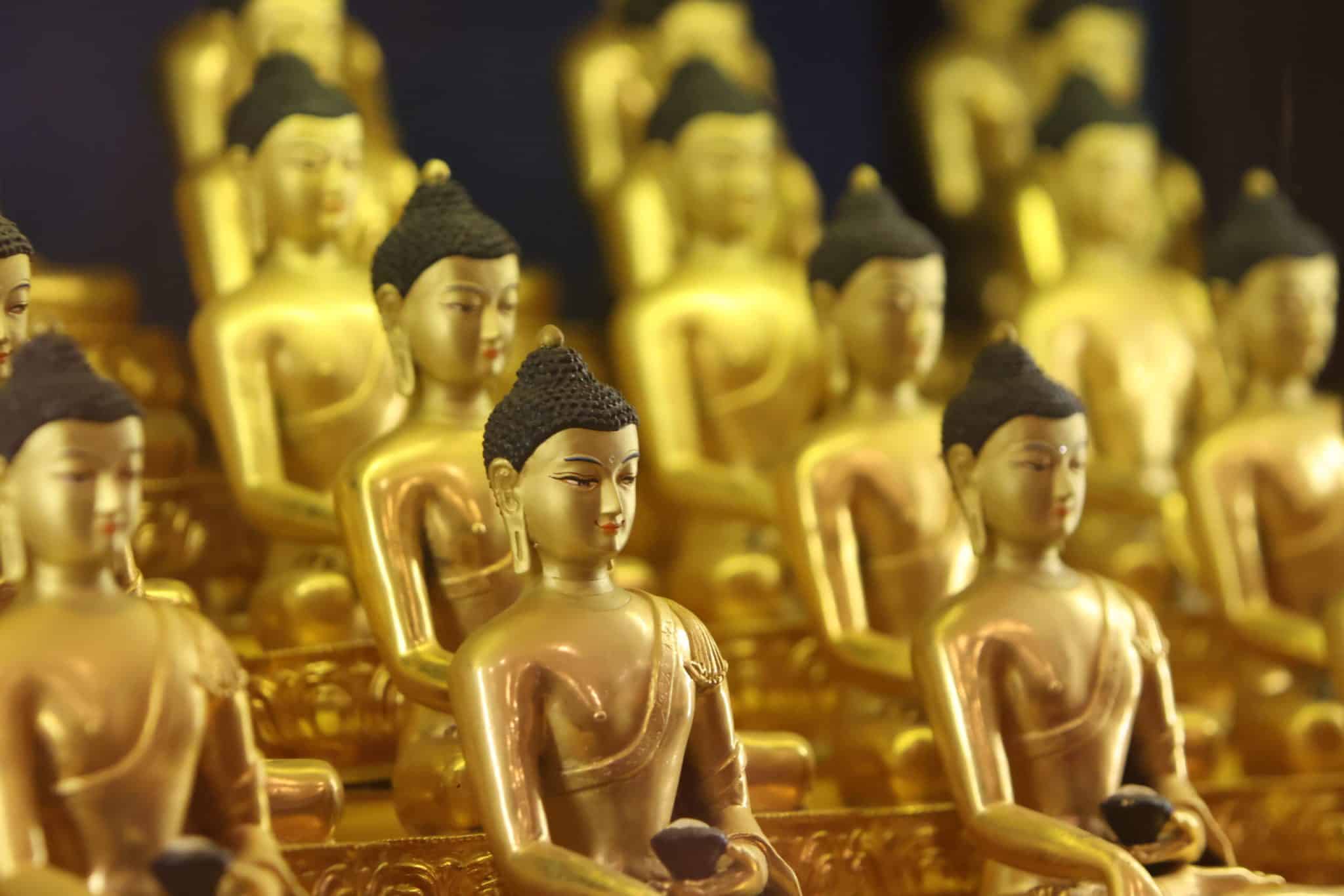

The Buddhist path begins where we are, as ordinary beings, and offers practical tools, such as meditation and mindfulness, to help us work with our minds, uncover our innate positive qualities, and work toward lasting freedom from suffering.
“The mind is the root of everything: the creator of happiness and the creator of suffering, the creator of samsara and the creator of nirvana.”
– Buddha Shakyamuni, Dhammapada
The Origins and Evolution of Buddhism
Buddhism, as we know it today, came into being over 2,500 years ago with the teachings of Buddha Shakyamuni, who lived in India and Nepal in the 6th century BCE. Based on the profound insights he gained through meditation, the Buddha taught a path of wisdom, compassion, and inner freedom.
As these teachings spread across Asia and beyond, they adapted to local cultures, giving rise to rich traditions of art, architecture, music, festivals, and even ancient universities. Yet, throughout the centuries the Buddha’s core message of wisdom and compassion has remained unchanged: each of us has the potential to awaken through understanding the nature of our mind.
Buddhism teaches that enlightenment, a supreme state where we are aligned with the ultimate nature of reality and immense qualities of clarity and love shine forth, is within reach. And even if that goal seems distant, the practical tools and insights of the Buddhist path can bring clarity, peace, and meaning to our everyday lives.
A Path of Compassion and Inner Peace
Through practices that cultivate and strengthen mental peace and compassion, we can begin to release the grip of ego and the patterns that cause suffering. Step by step, we reconnect with our true nature, a vibrant, loving presence that benefits both ourselves and others.
Read more about Meditation and Compassion.

Buddhism in Tibet
After spreading throughout Asia, the last direction to which Buddhism spread was to the Himalayan region and Mongolia. Buddhism was first introduced into Tibet in the 6th Century and became firmly established in the 8th Century during the time of King Trisong Detsen. It was during this period that the great Indian Buddhist masters like Shantarakshita, Guru Padmasambhava and Vimalamitra were invited to Tibet, and the country’s first monastery was founded at Samyé. Several schools developed over the following centuries, the foremost among them being the Nyingma, Sakya, Kagyü and Gelug.
Tibetan Buddhism is marked by a rich array of skilful methods which it has nurtured and perfected over hundreds of years. This includes basic meditation practices to calm and stabilise the mind; contemplative methods to awaken in us deep wisdom and vast compassion; visualisation practice, mantra recitation, and profound meditation to help us arrive swiftly at a direct realisation of our true nature and the nature of reality itself.
In recent decades, the traditions of Buddhism and Western science and technology have come together to yield important research on the benefits of practising meditation and compassion, and to develop ways these practical tools can be applied in medicine and psychology, education, environmentalism and other fields.

Learn More About Buddhism and Buddha's Life
Find out more about what the Buddha taught in this introductory collection of short teachings. They include teachings from Rigpa teachers, and masters from the Tibetan Buddhist tradition: Dzogchen Ponlop Rinpoche, Dzongsar Khyentse Rinpoche, Jetsün Khandro Rinpoche, Sogyal Rinpoche and others.
Find this collection on Rigpa’s online platform ‘Prajna’.
To help us reflect on the example of the Buddha and his life, and what it means to embark on a spiritual path, explore this collection of short teachings.
It also examines some of the fundamental topics of the Buddha’s teachings that are relevant for the entire Buddhist path, whether we are new to Buddhism or familiar with its principles.
‘Discovering Buddhism‘ gives an overview of Buddhism in terms of its history, key ideas traditions and practices.
Available from ZAM
‘A New Way of Seeing’ invites us to engage in the dynamic process of questioning what the Buddha said, allowing us to re-evaluate our own thinking and come to a new clarity.
Available from Troubador

